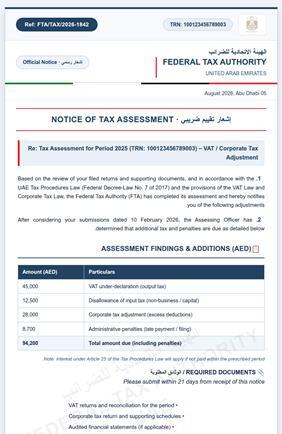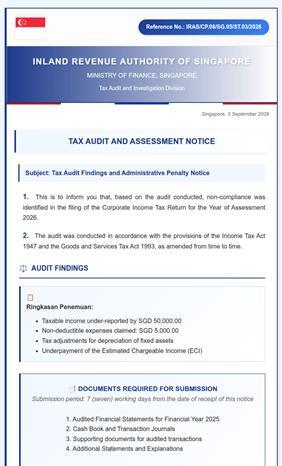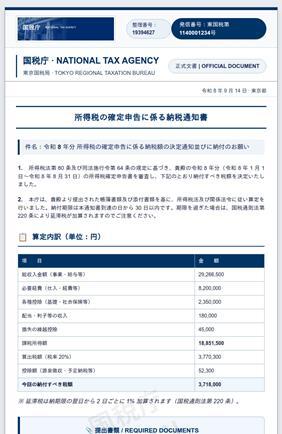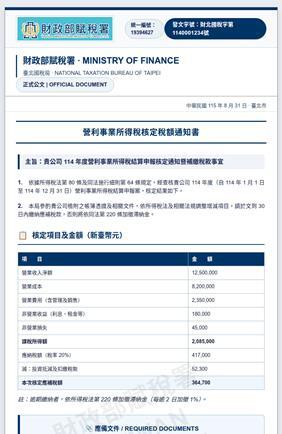



A long-running malware campaign continues to rotate geographic targets, localize government impersonation, and change execution paths – while preserving infrastructure and behavioral patterns that defenders can block across multiple layers.
Author: Oscar Herranz Martin, Whalebone Threat Intelligence Analyst
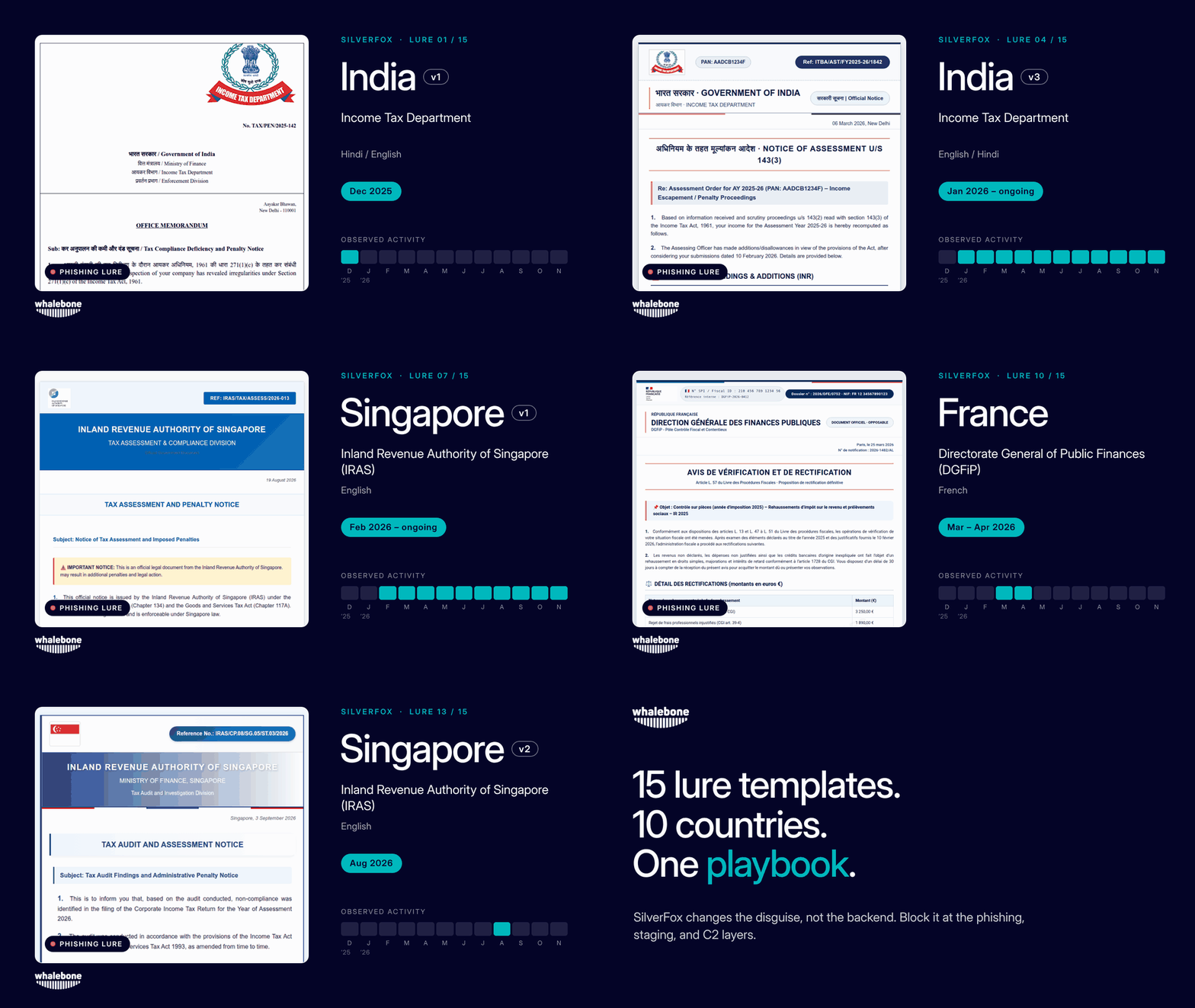
|
|
Known campaign, new chapter SilverFox is not a newly discovered threat operation. Earlier waves had already been widely investigated by December 2025, including campaigns built around fake income-tax assessment pages and multiple parallel delivery chains. Our current investigation shows that the activity did not end there: it remains active, has evolved technically, and has spread into additional target countries with new local government and tax-authority impersonation themes. |
Executive Summary and Key Findings
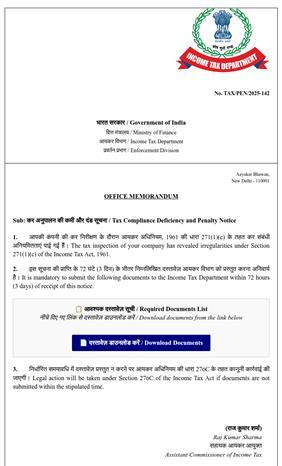
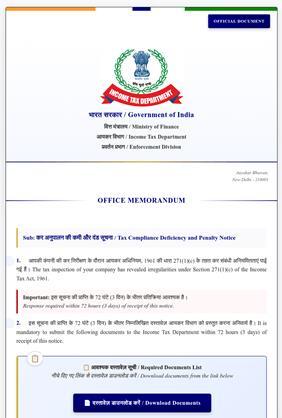
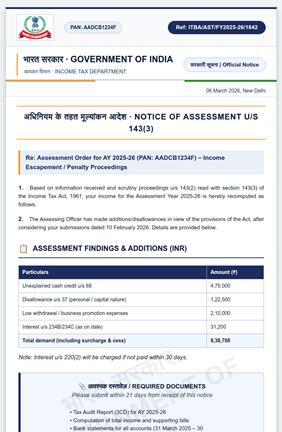
● A widespread cyber campaign, tracked by security researchers as SilverFox, mimics local tax authorities to trick victims into downloading fake tax assessment notices. Once the user clicks to download and fill out the "missing" documents, the infection chain begins. The malicious files are typically masked inside large archives that hijack legitimate Windows processes to secretly install remote control software.
● Once this remote control software is installed, a single click can quickly escalate into a full breach. The malware gives attackers control over the infected machine. This allows them to monitor the victim's screen in real time, steal passwords and sensitive files, or use the computer as a backdoor to infect a wider network.
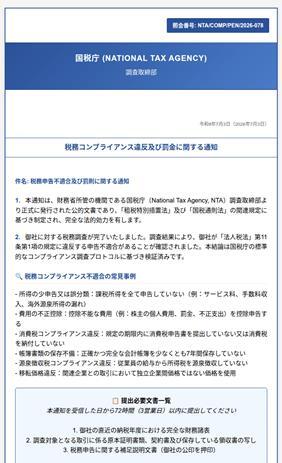
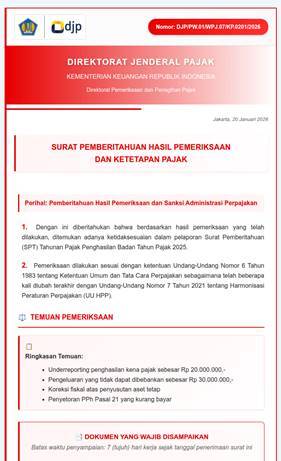
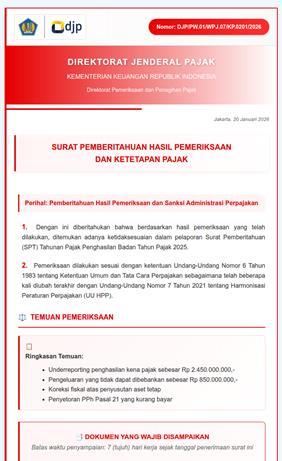
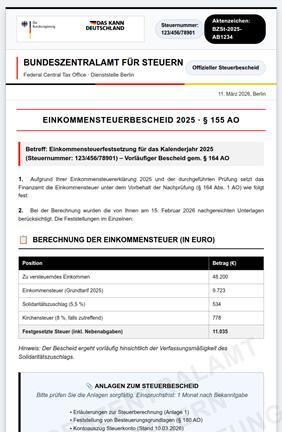
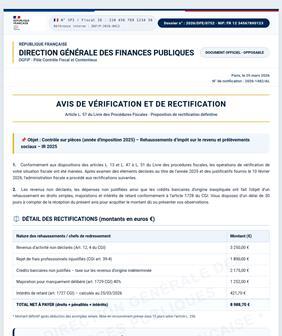
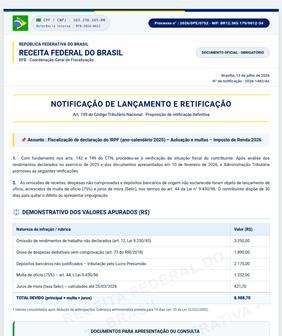
● While previous reporting on the campaign extensively covers its ongoing focus on the Indian Income Tax Department, our latest investigation describes a geographic expansion. The operation has moved into new Asian and Middle Eastern territories, deploying tailored, localized lures for Japan, Taiwan, Singapore, and the United Arab Emirates, alongside a recent resurgence in active templates targeting Malaysia and Indonesia. We also identified dormant frameworks for Germany, France, and Brazil, indicating broader expansion plans. Despite this global expansion, underlying Chinese-language developer artifacts remain present across all localized assets.
● This is a highly adaptable operation. The attackers constantly rotate their web domains, switch target countries, and evolve their evasion techniques. However, their underlying network behavior remains predictable. Because the attack relies on a multi-stage infection chain, defenders have three distinct opportunities to block it: at the initial phishing layer, at the intermediate payload download, and at the final Command and Control (C2) connection.
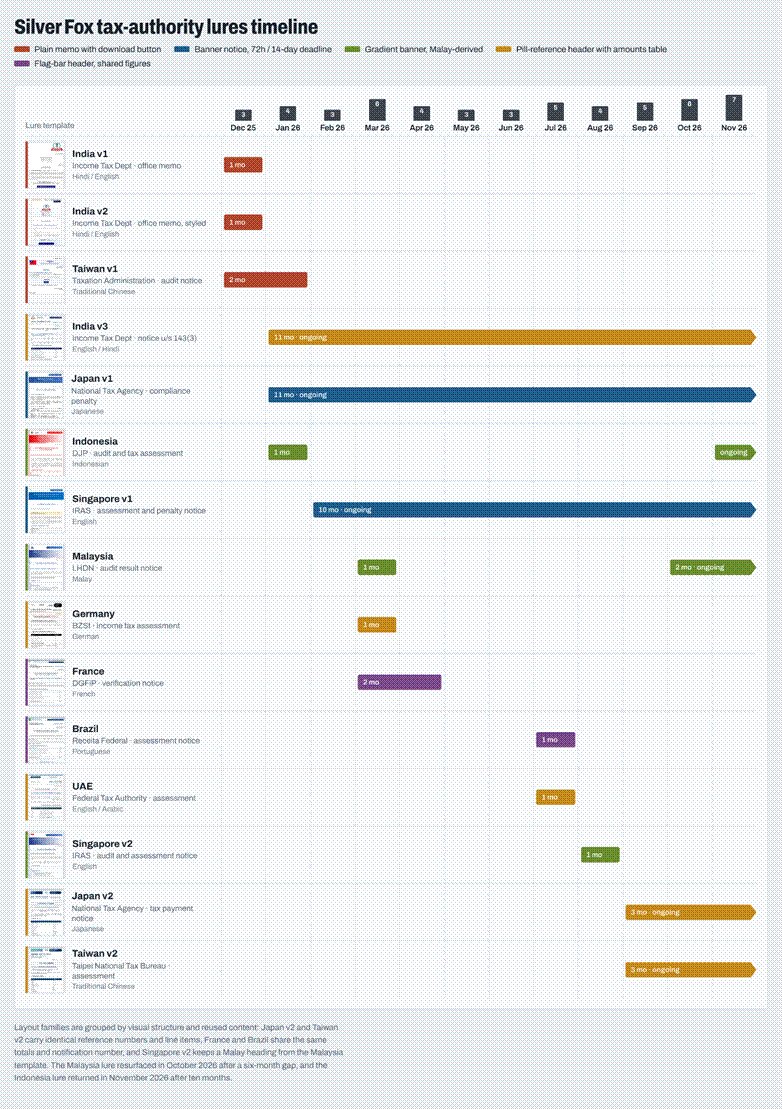
SilverFox lure templates by country, December 2025 – November 2026. The number above each month shows how many templates were active.
Global Targets and the Footprints Left Behind
SilverFox is expanding its geographic footprint and updating its toolset. While previous waves of this campaign leaned heavily on India, Japan, and Singapore, the operation has actively evolved. Not only have new targets like Taiwan emerged, but previous lures have received upgrades, featuring better frontends and localized branding.
One campaign model, many local identities
The attackers treat their phishing infrastructure like a global franchise. They swap out the language, government logos, and terminology to match the victim's jurisdiction. However, while the visual disguise changes by country, the underlying code, page logic, and malware delivery workflow remain largely the same.
The changes go beyond surface-level appearance, as the attackers have also diversified their malware droppers by country. For instance, in India, the actors are deploying loaders written in Rust (a programming language whose structure makes it much harder for security researchers to reverse-engineer).
Against targets in Taiwan, actors are, by contrast, deploying Delphi loaders (an older programming language favored for creating bulky, self-contained executables that easily hide malicious code from automated scanners).
Meanwhile, targets in Japan face modular scripts, showing the attackers are actively tailoring their payloads to specific countries.
|
Country |
Impersonation / Lure |
Observed or Prepared Theme |
|
India |
Income Tax Department |
Official tax notice / assessment |
|
UAE |
Federal Tax Authority |
Tax notification / document download |
|
Japan |
National Tax Agency / e-Tax |
Income-tax and invoice notices |
|
Taiwan |
Ministry of Finance / Taxation Administration |
Assessed-tax notification |
|
Singapore |
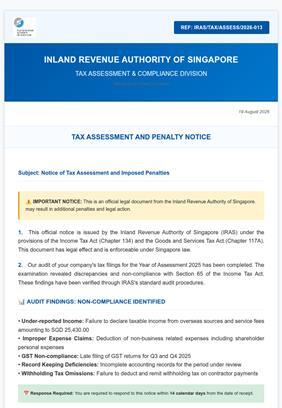
Inland Revenue Authority of Singapore |
Tax audit / penalty notice |
|
Malaysia / Indonesia / France / Germany / Brazil |
Tax-authority templates |
Additional localized template development observed |
Chinese language artifacts inside localized frontend code
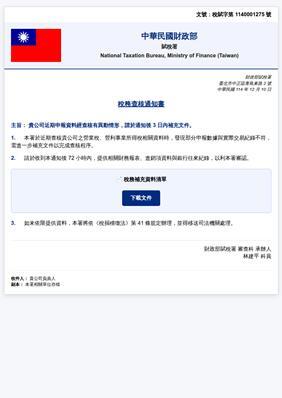
Despite the careful local disguises, the developers left behind clear operational fingerprints. By examining the source code of the non-Chinese phishing pages, we found hidden simplified Chinese developer comments that the victims never see. For example, behind the scenes of the Taiwanese tax lure, developers left a note in Chinese reminding themselves to remove the "warm Indian color scheme" and replace it with Taiwan's official dark blue.
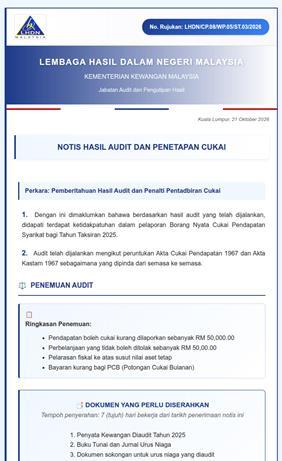
The Malaysian campaign provides even more concrete evidence. The operators built a convincing replica of the Inland Revenue Board of Malaysia (LHDN), but they left two distinct fingerprints in the code. First, the national flag image is sourced as 马来西亚images.png, using the simplified Chinese characters for Malaysia. Second, the developers used full-width Chinese punctuation marks inside the Malay text. This specific typographical error also appears in the latest Indonesian wave, pointing to a developer typing in English, Malay, or Indonesian while their system keyboard is still actively set to a Chinese input.
Because these artifacts tie a reusable development base to a Chinese-speaking environment, it is highly probable that a single, centralized Chinese-speaking group is maintaining the entire template family.
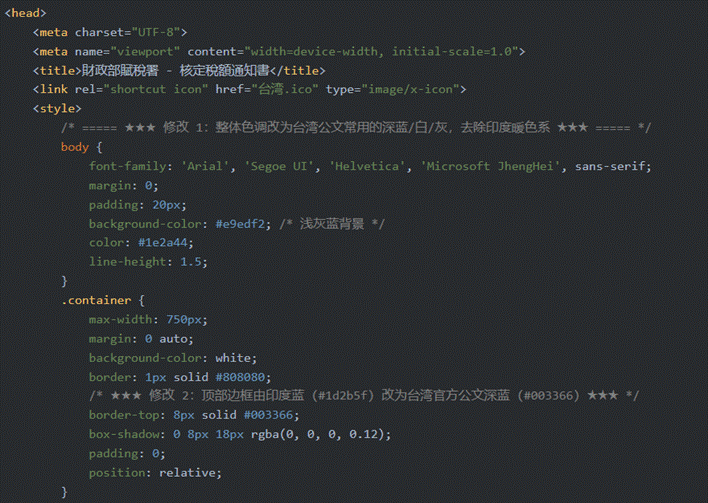
Taiwan localized site's DOM
修改 1:整体色调改为台湾公文常用的深蓝/白/灰,去除印度暖色系 → Amendment 1: Change the overall color scheme to the dark blue, white, and gray commonly used in Taiwanese official documents, and remove the warm Indian color scheme.
修改 2:顶部边框由印度蓝 (#1d2b5f) 改为台湾官方公文深蓝 (#003366) → Change 2: The top border has been changed from Indian Blue (#1d2b5f) to the deep blue used in official Taiwanese documents (#003366)
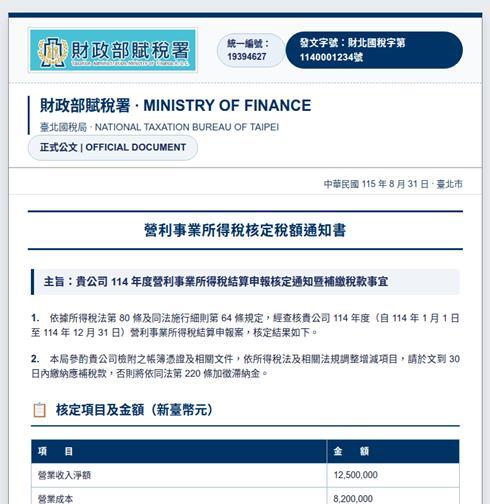
The Taiwan lure whose notice title and dark-blue top border match the code above.
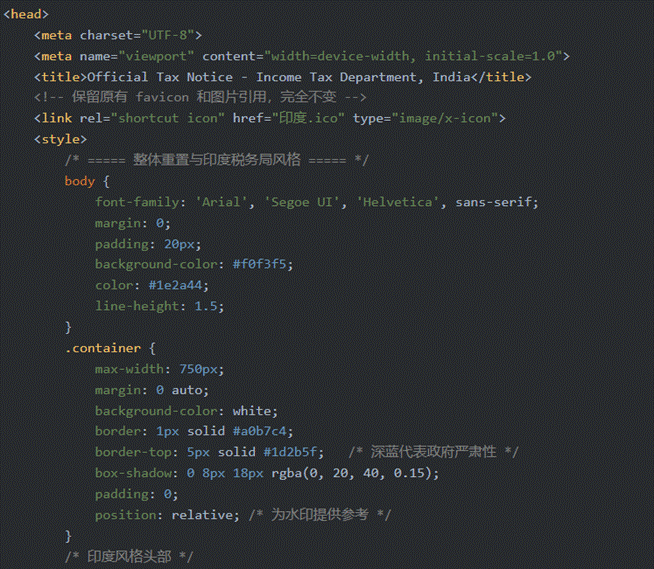
India localized site's DOM
保留原有 favicon 和图片引用,完全不变 → Retain the original favicon and image references; leave them exactly as they are
整体重置与印度税务局风格 → A complete overhaul in the style of the Indian tax authority
深蓝代表政府严肃性 → Deep blue symbolizes the government’s solemnity
为水印提供参考 → Provide a reference for the watermark
印度风格头部 → Indian-style headpiece

Malaysia localized site's DOM, simplified Chinese png

Full-width brackets ( ) mistakenly used in the localized Malay text
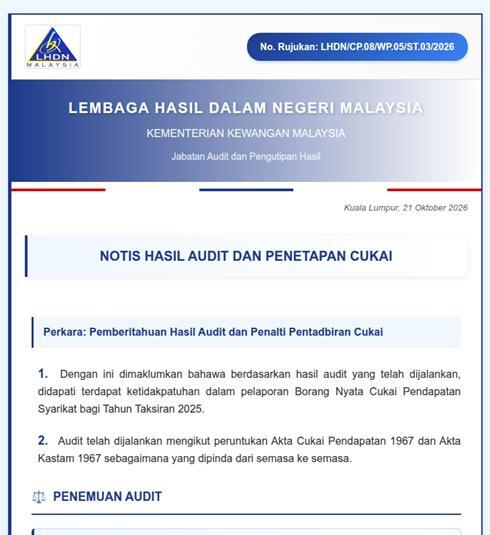
The Malaysian lure built from this code. Its reference number (LHDN/CP.08/WP.05/ST.03/2026) is the same one visible in the code above.
Tracking the backend infrastructure
The operators burn through new web domains rapidly to evade security blocklists, but their fundamental developer habits are much harder to change. Across all the different country templates, the attackers reuse the exact same backend administrative paths (such as count.php?action=visit or stats.json) to track victim clicks and downloads.
|
count.php?action=visit |
This gives defenders a significant advantage, since newly registered phishing domains may still reuse the same development conventions. This allows defenders to proactively hunt and block the servers by targeting these permanent backend structures rather than playing whack-a-mole with individual URLs.
Technical Deep Dive: Breaking Down the Infection
1. Bypassing Warnings with Containers (T1553.005)
Instead of sending the malicious files directly, the attackers hide them inside container files like ZIP archives or Virtual Hard Drives (VHD/VHDX). When a user downloads a normal executable from the internet, Windows tags it with a hidden "Mark of the Web" warning, popping up a security alert if the user tries to run it. By burying their files inside a VHD, the attackers strip away this warning tag, allowing the malware to execute without triggering built-in Windows alerts.
|
.ZIP |
2. Execution Vector and Import Hijacking
Subverting Trust via DLL Side-Loading
As seen in previous waves, this campaign heavily relies on hiding malicious code behind trusted applications. The attackers use DLL Side-Loading (T1574.002) and Masquerading (T1036) to execute their payloads. By renaming legitimate executables like WeChatAppEx.exe or SystemSettings.exe (as the one seen in the Japanese example) and placing an attacker-controlled DLL in the same folder, the malicious code automatically executes when the trusted application opens. This shifts the trust problem away from the executable itself and into the local working directory.
|
WeChatAppEx.exe / _CIT-20260831211253.EXE |
This technique does not require the host executable itself to be malicious.
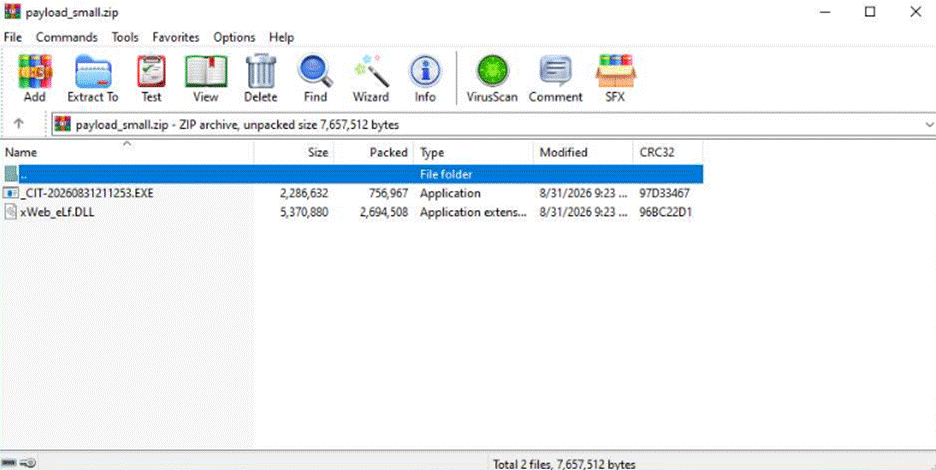
Contents of payload_small.zip: the renamed executable (_CIT-20260831211253.EXE) and the side-loaded xWeb_eLf.dll.
The recent Malaysian branch provides an example of this technique. The attackers ship a tiny ZIP file containing a legitimate, digitally signed copy of the Microsoft Accessible Event Watcher (accevent.exe) renamed to look like a tax document. Because this Microsoft tool is hardcoded to look for a specific dependency file and execute its DoSettingsDialog function upon startup, the attackers simply place their packed, malicious event.dll in the exact same folder.
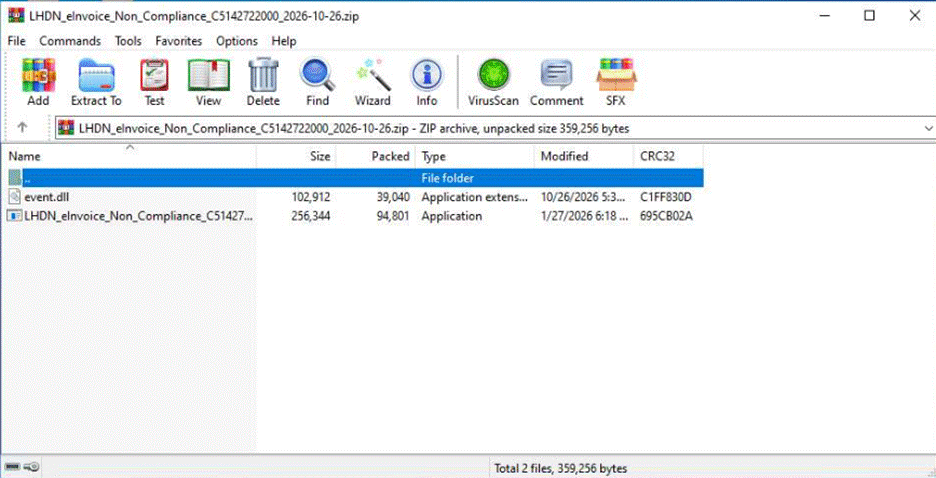
The Malaysian archive (about 134 KB compressed): the renamed accevent.exe and the packed event.dll.
When the victim double-clicks the fake invoice, Windows executes the trusted Microsoft code, which blindly loads and detonates the attacker's payload.
3. Defense Evasion and EDR Bypasses
Adaptive File Sizing (T1027.001)
The attackers adapt their evasion strategies to the specific payload. In some campaigns, to bypass antivirus upload limits and choke automated security scanners, the attackers intentionally inflate their malicious files to over 500 MB. Most security tools will simply refuse to process or upload a file that large.
However, the newest Malaysian variant takes the opposite approach. The attackers deploy a lightweight 134 KB archive containing a Stage 1 Downloader. This tiny file size easily slips past corporate email attachment filters and web gateway limits.
Native Windows transfer and execution tooling
Rather than carrying their own custom tools, the campaign abuses built-in Windows utilities to carry out its tasks. It uses tools like BITSAdmin to download secondary payloads (BITS Jobs, T1197; Ingress Tool Transfer, T1105) and command-line utilities to execute them (Command and Scripting Interpreter, T1059). The malware even attempts to manipulate MpCmdRun.exe, the native Microsoft Defender utility, to interfere with local security.
|
bitsadmin.exe /transfer <job> /download /priority foreground <URL> <output> |
Anti-VM and Custom Error Handling (T1497)
The malware actively checks if it is running inside a security researcher's virtual machine. It queries the system locale, timezone, and external IP address to ensure it is hitting a real victim in the target country. If these strict environmental checks fail, the malware intentionally crashes and throws a fake "0xc0000142" application error.
This error box explicitly instructs the user to extract all files and run them as an administrator. Standard Windows errors do not provide specific extraction instructions, which indicates this is a deliberate social engineering technique to force the user out of a protected sandbox environment.
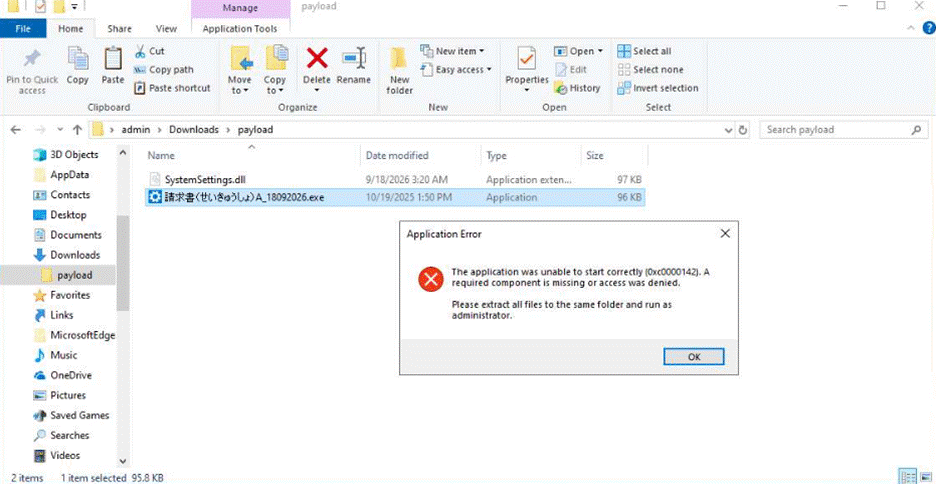
The fake 0xc0000142 error shown by the Japanese sample, which sits next to SystemSettings.dll. The message tells the user to extract all files and run as administrator.
Abusing Legitimate Web Services (T1608.001, T1105)
To keep their initial phishing files small and avoid detection by email gateways, the attackers frequently decouple the main malware from the initial download.
As observed in the latest Malaysian wave, the Stage 1 downloader acts merely as a scout. Once it confirms the target environment is valid, it reaches out to attacker-controlled repositories on legitimate platforms like GitHub (for example, fetching an encrypted 5.00 MB Stage 2 payload from a devin-update repository).
Because GitHub is widely trusted and heavily used in corporate environments, this malicious download easily blends into normal daily web traffic, bypassing network firewalls that would normally block downloads from unknown domains.
4. C2 and Payload Execution
Country-Specific Payloads and Process Injection
While the early stages of the attack share common infrastructure, the final payloads vary heavily depending on the country. As detailed in the technical breakdown, Indian targets are hit with Rust-based loaders, Taiwanese targets face Delphi-based loaders, and Japanese targets encounter modular scripts.
backgroundTaskHost.exe injection
|
initial lure / loader |
A recent Malaysian wave introduces yet another variation. Instead of delivering a bulky payload right away, the attackers deploy a lightweight Stage 1 downloader. Once this tiny file confirms it is running on a real Malaysian computer, it quietly connects to a malicious GitHub repository to pull down an encrypted Stage 2 payload.
RuntimeBroker.exe injection (latest Malaysian wave)
|
initial lure / loader |
The latest Indonesian wave introduces a new execution method. In this branch, the attackers hijack a legitimate Evernote application file (ED.44211047.exe) to launch their payload. This payload includes a hidden process (telemetry-dll-ramp-value.exe) which, once running, connects to a new command and control server at cajefez[.]club. In this specific case, rather than waiting for instructions, it immediately leaks the victim’s computer address, name, and operating system details directly in the connection request to the C2 domain.
telemetry-dll-ramp-value.exe injection (latest Indonesian wave)
|
initial lure / loader |
Regardless of the specific loader, the execution sequence ultimately transitions into legitimate Windows processes to hide its activity. The malware uses Process Injection (T1055) to secretly take over normal Windows programs like backgroundTaskHost.exe or ngen.exe. Because the injected process is a trusted Windows component usually communicating over standard TCP/443 (Application Layer Protocol, T1071), the malicious traffic easily blends into the daily background noise of the network.
ngen.exe injection and ValleyRAT / Winos4.0
|
loader chain |
While ValleyRAT and Winos4.0 are the main tools we see in this campaign, finding them does not automatically tell us exactly who is behind the keyboard. These specific malware builders are widely shared on underground forums, and the same servers pushing this malware are also known to push other tools and even legitimate remote-admin software.
Because of this, we cannot pin the attacks on one specific group just based on the malware family alone. The real fingerprint of this campaign lies in how the attackers combine their localized fake tax pages, their side-loading tricks, and their reusable server backend.
Shared Japanese and Taiwanese staging
Lures for different countries converge on shared infrastructure. Japanese and Taiwanese chains both use devin-us[.]com / 103.59.101.28:443 and the same API-style download structure with different UUIDs. This is an important defensive pattern: the victim-facing pages can look unrelated while the backend delivery layer remains common.
|
hxxps://devin-us[.]com/api/file-share/<UUID>/download |
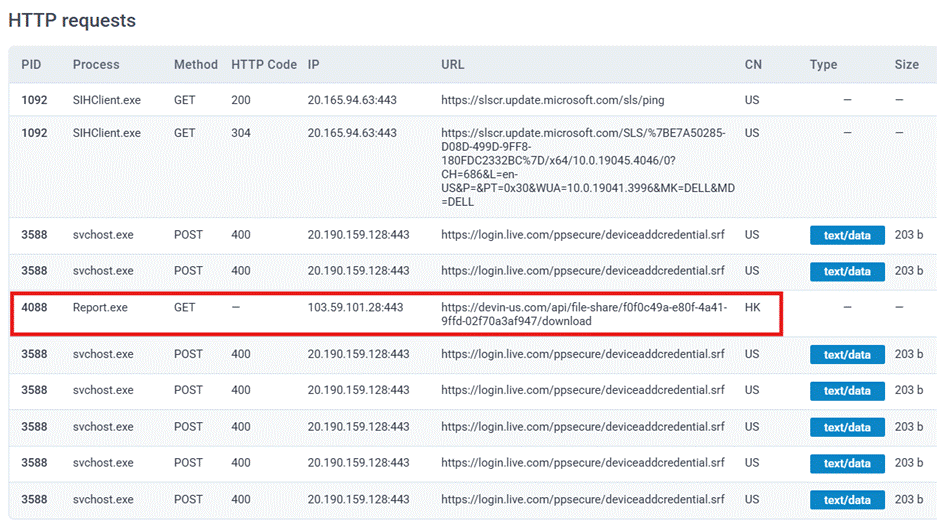
Sandbox network log for the Taiwan sample. Report.exe requests its payload from devin-us[.]com (103.59.101.28:443), highlighted in red.
Cross-Country Convergence: What Changes, What Persists
The core operational model of the campaign relies on flexible, localized disguises that all feed into a permanent, shared backend. By analyzing the attacks across India, Japan, Taiwan, Malaysia, and Indonesia, a clear pattern emerges showing exactly how the operators behave and adapt.
What Changes (The Disguise): The attackers completely customize the social engineering layer to match the local jurisdiction, whether impersonating the UAE Federal Tax Authority or the Inland Revenue Board of Malaysia. They also frequently rotate their initial delivery mechanisms. For example, the host executables change by country (varying between tools like WeChatAppEx.exe, accevent.exe, and legitimate Evernote binaries) and the evasion tactics shift. Some payloads rely on 500 MB file bloating to choke scanners, while others use lightweight 134 KB downloaders to slip past email gateways.
What Persists (The Core Infrastructure): Despite these localized disguises, the underlying mechanics remain consistent across all countries. The malware consistently relies on DLL Side-Loading to execute, uses Process Injection (T1055) to hide inside legitimate Windows processes (like RuntimeBroker.exe, TaskHost.exe, or telemetry-dll-ramp-value.exe), and ultimately connects back to shared Command and Control infrastructure (such as the devin-us[.]com cluster), typically over TCP/443.
Because these disparate country-specific campaigns share the same technical chokepoints, it is almost certain that a single, centralized operation is managing the entire global footprint.
|
localized lure |

Technical Breakdown
The table below summarizes representative branches from the investigated dataset. Domains and IP addresses are shown as defensive indicators and should be continuously revalidated because attacker infrastructure can be reallocated or repurposed.
|
Target / lure |
Container / delivery |
Side-loaded DLL / execution |
Defense evasion |
Payload / framework |
Infrastructure |
|
India tax |
IMG / ZIP |
HealthDashboard.exe -> obtoJB32.dll -> backgroundTaskHost.exe |
UAC / injection / staged download |
Rust loader / secondary trojan |
103.118.243.73:443 |
|
Tax-Number / localized tax |
VHDX |
Legitimate host + side-loaded dependencies -> ngen.exe |
Container evasion / padding / process injection |
ValleyRAT / Winos4.0 |
103.97.131.179:6666 |
|
Japan tax / e-Tax |
ZIP / IMG |
SystemSettings.exe -> SystemSettings.dll; other staged DLLs |
Side-loading / staged retrieval |
Modular SilverFox-linked loader |
e-tzxarw[.]jp; 103.23.172.118; devin-us[.]com |
|
Taiwan eTax |
ZIP |
Report.exe -> badata_x64.dll |
Side-loading / staged download |
Delphi-based loader |
devin-us[.]com; 103.59.101.28:443 |
|
UAE FTA |
HTML / staged archive |
Localized page -> secondary download chain |
Infrastructure rotation / staged payloads |
Multi-stage loader |
kaiwyrey[.]eu[.]cc; 103.23.172.118; rotating .cc/.cfd endpoints |
|
Singapore IRAS |
ZIP / script-assisted delivery |
Scripted execution / secondary payload |
Native tooling / staged retrieval |
Scripted loader |
Rotating .cc/.eu.cc/.cfd staging |
|
Original VHD branch |
VHD |
WeChatAppEx.exe -> xWeb_eLf.dll |
MOTW complication / file padding / BITSAdmin |
Winos4.0 |
ayowo8b.club; 207.56.119.215:7800 |
|
Malaysia Tax Audit |
ZIP |
accevent.exe -> event.dll -> RuntimeBroker.exe |
Environment checks / fake error / process injection |
Stage 1 downloader / encrypted Stage 2 |
GitHub staging / devin-us[.]com; 103.59.101.28:443 |
|
Indonesia DJP |
ZIP to UDF IMG |
ED.44211047.exe -> ENCRASHREP.dll -> telemetry-dll-ramp-value.exe |
Obfuscated payload directory / stripped metadata / host profiling |
System profiler / stealer |
biaoisdiu[.]work / cajefez[.]club; 163.61.31.226:443 |
The Defense Angle: Why Multi-Tier Network Blocking Matters
SilverFox is designed to survive change. Domains rotate, country branding changes, loader families evolve, and operators alternate between final payloads like ValleyRAT and commercial remote monitoring tools. The attacker still has one unavoidable requirement: each stage must communicate with infrastructure outside the victim device.
That creates three independent network-level interception opportunities. Blocking at more than one layer is important because no single control has to be perfect for the infection to fail.
Layer 1: Surface phishing and impersonation domains
The first layer is the victim-facing infrastructure: fake government portals, cloned tax notices, document-delivery pages, and localized public-service branding. Blocking here provides the cleanest outcome because the lure never reaches the user and no payload is downloaded.
|
|
What we block at Layer 1 New or known domains that reproduce campaign templates, reuse backend logic, exhibit campaign naming/infrastructure relationships, or impersonate local tax and government services. |
Layer 2: Intermediate payload download infrastructure
If a victim bypasses the first layer and reaches the phishing page, the attack still relies on an intermediate server to deliver the Stage 1 downloader or bloated archive. This secondary infrastructure often remains stable even as the attackers rapidly burn through their front-end phishing domains.
|
Representative staging / delivery infrastructure |
This is where multi-tier intelligence provides leverage: a previously unseen phishing hostname can still fail because its secondary download domain or IP has already been correlated with the campaign.
Layer 3: Active C2 and remote-control infrastructure
If the payload executes, outbound command-and-control becomes the final containment opportunity. Because some branches of this campaign connect directly to IP addresses rather than domains, defenders must implement broader network layer enforcement beyond basic DNS blocking.
|
207.56.119.215:7800 (ayowo8b[.]club) 163.61.31.226:443 (cajefez[.]club) |
Even if a host executes a side-loaded DLL and hollows out a trusted Windows process, blocking the final C2 socket isolates the machine and prevents the operator from gaining remote access. This is the key value of defending beyond the phishing page.
|
LAYER 1 Phishing / impersonation Stop the victim journey before payload delivery. |
LAYER 2 Payload staging / download Break the infection chain after the click but before full execution. |
LAYER 3 C2 / remote control Contain execution by denying operator connectivity and follow-on modules. |
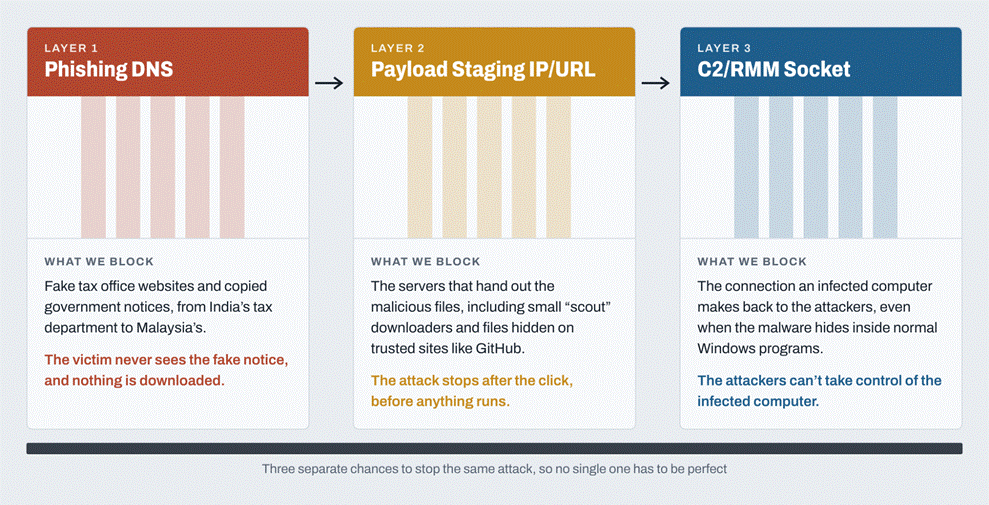
Operational implication
Single-point detection ages quickly against an operation that continuously changes domains and payloads. A bloated file can bypass automated scanners, a signed executable can weaken simple reputation logic, and process injection can obscure the originating loader.
However, every execution stage still generates observable network traffic. The objective for security teams is not to permanently block every historical IP address, as shared hosting environments change hands frequently. Instead, the focus should be on rapid blocking of active infrastructure while hunting for the permanent developer fingerprints that survive these infrastructure rotations.
Conclusion
It is almost certain that SilverFox is not a finished incident or a localized malware family. The campaign remains operational, and it is highly probable that the actors will continue expanding geographically. They will likely keep rebuilding their local government lures while swapping out their underlying containers and loaders.
As demonstrated across the Malaysian, Taiwanese, and Japanese campaigns, the visual lures and initial droppers do not need to match. Underneath those country-level changes, the operation still depends on the same broad sequence: reach the victim, deliver or activate code, and connect the compromised device to attacker-controlled infrastructure.
That dependency is the defensive opportunity. By blocking the campaign across the impersonation layer, the intermediate payload layer, and the active C2 layer, defenders gain multiple independent chances to stop the same infection. For an operation built around continuous rotation and localization, that redundancy is what turns threat intelligence from a static list of indicators into durable network protection.
Appendix: Lure gallery
The lure screenshots captured during the investigation, in the order the templates first appeared. Every page shown here is a fake: the government names, logos, and notices are copies made by the attackers, and none of them is an official document. Two Indonesian captures are included; they differ only in minor details.
|
India v1 |
India v2 |
Taiwan v1 |
|
India v3 |
Japan v1 |
Indonesia (capture 1) |
|
Indonesia (capture 2) |
Singapore v1 |
Malaysia |
|
Germany |
France |
Brazil |
|
UAE |
Singapore v2 |
Japan v2 |
|
Taiwan v2 |
|
|